
How to Check Criminal History in Seneca
Begin a Seneca criminal history search with the office that made or now holds the record. A city police report and a city court docket document different stages. The booking sheet belongs to Oconee County, while the state repository depends on fingerprint and disposition reports. Use names with care, and add the incident date, street, case number, or report-listed role whenever known.
- Ask Seneca Police for the incident or accident report by email, phone, form, or at its records counter.
- Give the date, location, report-listed name, and enough detail to locate the exact Seneca record.
- Call Seneca Municipal Court for a traffic, ordinance, or lower criminal case handled by the city.
- For booking or a General Sessions prosecution, use the Oconee detention and county court channels.
- Use SLED CATCH when a statewide South Carolina repository report is needed.
A recent Seneca arrest may not yet have a filed court case. Conversely, a court disposition may show that the charge changed or ended without conviction. Check each stage that matters.
Seneca Criminal Records on Depot Street
The official Seneca Police page identifies the city records channel at 205 North Depot Street. Requests may be sent to records@seneca.sc.us or discussed at 864-885-2718. The department receives mail at P.O. Box 4773, Seneca, SC 29679. That direct route is best for a report created by a Seneca officer, including the narrative and event details that a court index may not reproduce.

The image reflects the official Seneca Police source used to confirm the local counter and contact methods. A request should identify an existing record, not ask city staff to compile an open-ended criminal history.
The Seneca Police Department
Seneca Police keeps incident, accident, and arrest reports made by its officers. Its published police request form separates accident reports from incident reports. It asks for the request date, requester and phone number, incident date, names on the report, event address, and detailed information. A case number is useful when available. The form also tells the requester to be ready to show identification at pickup.
Those fields explain why a narrow Seneca request moves faster than a name-only demand. Give the record type, date, location, and your role in the event. The narrative can contain protected victim, witness, juvenile, medical, or active-investigation material, so a released copy may be redacted. A city police report records the officer’s work and allegations; it is not proof of guilt and does not replace the later court result.
Seneca Accident or Incident Form
The Seneca Police Records Request form offers the most direct written route for a local report. It distinguishes the two common record types at the first field, then gathers facts that tie the request to a specific Seneca event.
| Record choice | Accident Report or Incident Report |
|---|---|
| Event details | Date, location, and names listed on the report |
| Requester details | Name, phone number, and request date |
| Extra facts | Case number, role, and a clear description when known |
| Pickup | Be ready to provide identification |
The failed manifest capture for the downloadable PDF is not substituted with another image. The form itself remains the official source, and its fields make clear what Seneca needs to find the record.
Arrests and Bookings in Seneca
Seneca does not keep arrestees in a separate city jail. Seneca Police transports them to the Oconee County Detention Center at 300 South Church Street in Walhalla. The city report documents the arresting officer’s account. Oconee County then creates the booking number, intake time, fingerprints, photograph, charge and hold list, bond information, and release status.
No verified Seneca arrest blotter, police app, or city booking portal was found in the official research. For current custody, contact the detention operation through the Oconee Sheriff’s Judicial Services channel. For a booking sheet, use the Sheriff’s public-record request route. Return to Seneca Police for the incident narrative. This split matters because the jail cannot supply every fact held in the city case file.
Seneca Fingerprints on Two Afternoons
Seneca offers a distinct local fingerprint service on Tuesday and Thursday from 1 to 3 p.m. The person first pays at the City Hall front desk, keeps the receipt, and then brings it to police dispatch at 205 North Depot Street. The official page did not publish the fee in the inspected text, so confirm the cost before going.
This Seneca service captures fingerprints; it does not itself issue a criminal-history result. Seneca also states that the service is not for concealed-weapons-permit fingerprints. For a record tied to fingerprint identity, use the instructions of the agency that requires the card and confirm that the local capture method is accepted. SLED remains South Carolina’s central criminal-history repository.
The distinction is important for Seneca self-review. CATCH is a name-and-birth-date search, while a fingerprint card can support a stronger identity match in an authorized process. A changed spelling or alias can weaken a name-only result. Seneca Police provides the local capture service, but the office requesting the fingerprints controls the form, destination, and acceptance rules.
Note: Payment at Seneca City Hall and fingerprint capture at police dispatch are two separate steps in the same local process.
Seneca Municipal Court Records
Seneca Municipal Court sits at 225 East North 1st Street and may be reached at 864-885-2731. The counter is open weekdays from 8 a.m. to 5 p.m. The court handles traffic and criminal matters that occur within Seneca city limits and does not hear civil cases. No verified city case-search portal was located, so the clerk’s phone and counter are the sound ways to ask about a Seneca municipal docket.
The official Seneca Municipal Court page supplies the court’s scope, contacts, payment rules, and missed-court direction.
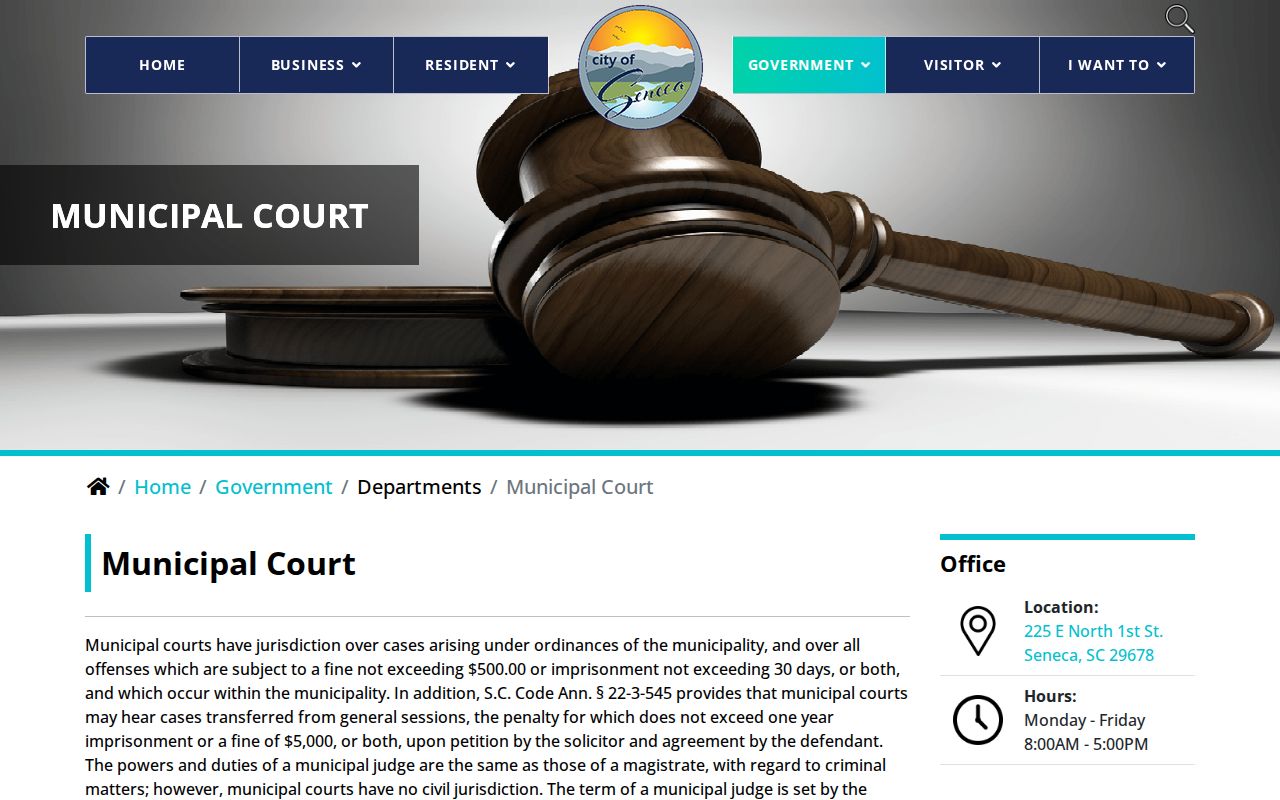
This view helps distinguish the city court channel from the Oconee County General Sessions index. Ask the Seneca clerk for the case number and current status before seeking a copy.
| Court | Seneca Municipal Court |
|---|---|
| Case types | City traffic, ordinance, and criminal matters; no civil cases |
| Lookup channel | Clerk phone or counter; no verified online city docket |
| Docket contents | Charge, hearings, plea or trial result, sentence, and warrant status when public |
| Copies and fees | Ask the clerk; no inspected city copy schedule was found |
Missed Seneca Criminal Court Dates
Seneca instructs a person who missed court to contact the court at once. Do not assume that paying later cancels a warrant or closes the case. The municipal clerk can confirm the Seneca docket, whether the judge issued process, and the next procedural step. A judge, not a payment receipt or website entry, controls warrant status.
The court accepts cash, money order, debit card, or credit card for eligible in-person payments. Mailed payments must be a money order or cashier’s check. Seneca does not accept personal checks, phone payments, or online payments under its published rules. Some matters require an appearance. Court staff also cannot arrange private discussion with the judge about a pending case.
Where Seneca Records End Up
A Seneca event can produce several linked but separate records. Police write the report. Oconee County books a person after arrest. Seneca Municipal Court keeps a city-level case if it stays within local jurisdiction, while higher prosecution proceeds in the Court of General Sessions. Fingerprint and court reports can then update the South Carolina Law Enforcement Division repository.
Record flow: Seneca Police Department › Seneca Municipal Court or Oconee County Courts › South Carolina Law Enforcement Division
Use the newest custodian for the newest fact. Seneca Police is best for the event narrative. Oconee detention is best for county booking status. The court file is best for the filed charge and outcome. CATCH offers a statewide name-based repository product, but missing fingerprints or late disposition reports can create gaps. The broader Oconee County criminal-history overview explains how those county and state layers differ.
Seneca FOIA Department Routing
Seneca also publishes a citywide Freedom of Information Act form. It lets a requester mark City Police or Municipal Court, an important choice because the same incident may lead to records in both departments. The form accepts a description and date range, then offers email, pickup, or postal delivery. It can be sent to foia@seneca.sc.us or mailed to P.O. Box 4773, Attention: Municipal Clerk.
The city calculates paper copies, staff time, and postage at actual cost under state law and accepts check, cash, or card. A request for a known incident report may fit the police form; a broader set of existing city records may require the Seneca FOIA route. Preserve the sent form and date. The city’s 2025 revision makes the department and delivery choices explicit.
Older Seneca Criminal Case Records
A city search does not end at the city counter when the matter became a felony prosecution. Search the Oconee Public Index for a General Sessions file. The county’s computerized index reaches back to 1994. Older cases require the Clerk of Court’s research books at 205 West Main Street in Walhalla. Clerk staff provide copies for a fee but do not conduct an open-ended name search for a visitor.
Arrive with a name, approximate year, or case number. An Oconee General Sessions number commonly includes GS-37, with 37 identifying Oconee County. Read the final disposition rather than relying on the first charge. “Nolle prossed” means the prosecutor did not continue that charge; it is not a conviction.
Seneca Criminal Records in Context
Seneca was the county’s largest incorporated city at the 2020 Census, with 8,850 residents. That size helps explain why Seneca publishes the most detailed municipal records workflow among Oconee’s three largest cities. Yet the city still shares the county booking hub and higher court. The practical divide is based on who created the document, not on where a reader happens to live.
The official City of Seneca homepage provides the source context for municipal services and city information.

The official city image anchors the local setting, while the police and court sources identify where Seneca criminal records are actually maintained.
Public Access Rules for Seneca Records
South Carolina law gives access to many existing Seneca public records, but it also permits redaction and withholding. A public body normally decides a request within ten business days, or twenty business days for records older than twenty-four months. Approved production normally follows within thirty calendar days, or thirty-five for older records, unless the parties agree otherwise. The city may charge reasonable actual search, retrieval, redaction, and copy costs and may seek a deposit of up to twenty-five percent.
Key Statutes:
South Carolina Freedom of Information Act sets access, response, cost, and exemption rules for Seneca records.
S.C. Code §30-2-50 restricts commercial solicitation using personal information obtained from government.
S.C. Code §17-1-40 governs destruction and sealed retention of records after a qualifying expungement.
Protected juvenile data, victim and witness identifiers, medical facts, and active-investigation material may not appear in the released Seneca copy. Ask for the segregable public portion when part of a record is exempt.