
Criminal Cases in the Oconee County Courts
The South Carolina Judicial Branch directory places Oconee County in the Tenth Judicial Circuit. The Court of General Sessions handles felony and other criminal matters beyond lower-court jurisdiction. Magistrates conduct bond functions and hear matters within their authority. Seneca, Walhalla, and Westminster also maintain distinct municipal paths for city traffic, ordinance, and lower-level criminal cases. A search limited to General Sessions can therefore miss a city case or a bench warrant tied to municipal court.
The elected Oconee County Clerk of Court keeps General Sessions case files. The Clerk is the custodian, not a research service. Staff can provide copies for a fee after a requester identifies the file, but they do not perform an open-ended name history or give legal advice. Court records answer what was filed and how the case ended. Police narratives and Oconee County booking records remain with other agencies.
The Tenth Circuit Solicitor prosecutes General Sessions matters and administers local diversion and expungement routes. The Oconee public defender listing identifies the appointed-counsel channel for a financially eligible accused person when imprisonment is possible. Neither office replaces the Clerk for public case-file research.
Inside Oconee County's Case Index
The free Oconee County Public Index is the main remote entry point for General Sessions records. A case detail may show the county and case number, filing or indictment date, parties, charge text, statute or offense code, arrest and offense dates, bond entries, court events, disposition, and sentence data. Not every docket line includes a document image. A missing image does not mean the filing never existed.
Use the result as a map to the official case file. Match more than a common name, and note the court, dates, and case number before requesting copies. Charges may be changed or replaced after an arrest. The final disposition row is the better source for the outcome.
How to Search Case Records
Begin online when the matter is recent enough for the computer index. The Oconee County Public Index supports name, case-number, case-type, and filing-date searches. Spelling variants may help, but broad results must be checked with care. Follow these steps:
- Open the Oconee County Public Index and select the criminal or General Sessions context shown by the live interface.
- Search by case number when known. Otherwise, enter the last name and add first or middle name details to narrow the list.
- Use case type and filed-date fields to separate people with similar names and to focus on the likely year.
- Open the docket. Record the charge, events, disposition date, bond entries, and sentence rather than relying on the result heading.
- Ask the Clerk for a paper or certified copy by case number when the online detail is incomplete or formal proof is needed.
The live labels can shift between portal versions. The researched functions are:
| Field Label | Type | Required | Notes |
|---|---|---|---|
| Case Number | Text | No | General Sessions numbers follow YYYY-GS-37-NNNNN. |
| Party Last Name | Text | No | Try known spelling variants with care. |
| Party First Name | Text | No | Narrows a surname search. |
| Party Middle Name | Text | No | Optional extra identifier. |
| Case Type | Dropdown | No | Available groupings depend on the portal view. |
| Date Filed From / To | Date | No | Limits results to a filing range. |
Pre-1994 Oconee County Case Records
The county states that its public computer court index begins in 1994. Earlier Oconee County criminal cases are indexed in research books at the Clerk's office. This is more than a slow online search. The old record path uses a different finding tool.
Bring a full name, approximate year, and any known charge or case detail to the Clerk at 205 West Main Street, Walhalla. The office is open weekdays from 8:30 a.m. to 5 p.m. and can be reached at 864-638-4280. Search the books to locate the case number, then request the specific file or copy. The Clerk charges copy fees, but the reviewed county source did not publish a per-page or certification amount.
The Oconee Clerk of Court page documents that research boundary and counter policy.
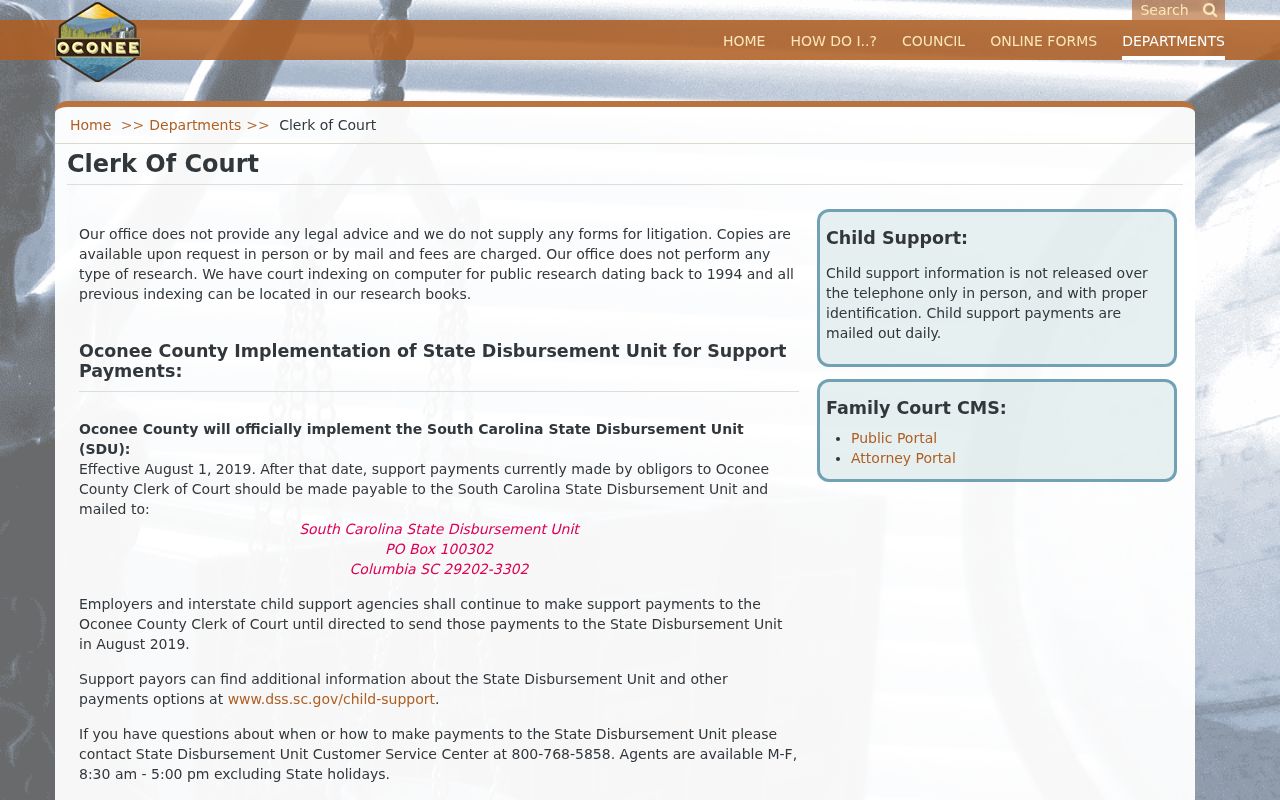
The captured office page confirms why a case number and date range make an in-person or mail request far more precise.
What the Case File Shows
A criminal case file is case-centered. It can provide richer court history than a booking sheet or a SLED name check. Read each charge separately because one count may be dismissed while another ends in a plea or verdict.
| Case Number & Court | Identifies Oconee County, General Sessions or another court, and the unique matter. |
|---|---|
| Charging Document | Shows the complaint or indictment and the charge presented to the court. |
| Docket Entries | List filings, hearings, motions, pleas, and other events in date order. |
| Parties & Counsel | May identify the defendant, prosecutor, agency, and attorneys where entered. |
| Bond | May show amount, type, status, and later court action. |
| Disposition & Judgment | Records whether each charge ended in conviction, dismissal, acquittal, or another outcome. |
| Sentence & Conditions | Shows the court-ordered consequence after a conviction. |
Protected identifiers, victim information, and some juvenile or sealed material will not appear in the public view. Ask the Clerk about a docket entry that lacks an image rather than treating it as blank.
Decode Oconee County Case Numbers
A General Sessions number such as YYYY-GS-37-NNNNN carries useful clues. The year marks the case year, “GS” means General Sessions, and “37” is Oconee County's code. The final digits identify the individual matter. A “CP” prefix belongs to Common Pleas, while magistrate and municipal courts use different formats.
Do not infer guilt from a prefix. It identifies the filing system, not the outcome. The same caution applies to docket terms:
- True bill
- The grand jury returned the indictment.
- No bill
- The grand jury declined the proposed indictment.
- Nolle prosequi
- The prosecutor formally chose not to continue that charge.
- Disposition
- The recorded way a charge ended.
- Bench warrant
- A judge's order, often tied to failure to appear or comply, not a new guilty finding.
Note: Read the outcome for each charge because a single Oconee County case can contain counts with different results.
Stages of a Criminal Case
An Oconee County criminal case may begin with an arrest or summons and an initial bond proceeding before a magistrate. The prosecutor then reviews the matter. A General Sessions prosecution may proceed by indictment and true bill, followed by arraignment, discovery, motions, a negotiated plea or trial, judgment, sentence, and possible appeal. “Pending” means no final result has been entered.
Case flow: Charges Filed → Arraignment → Pretrial → Plea or Trial → Disposition → Sentencing
A booking charge is only the charge stated at intake. The charge filed by the prosecutor can change, and the court's final outcome can differ again. Readers tracing that transition can compare the custody event with the fuller Oconee County arrest history process.
Oconee County Municipal Case Paths
Lower-court records do not all feed into one local search screen. Seneca Municipal Court handles traffic and criminal matters arising within Seneca, not civil cases. Walhalla Municipal Court keeps its own city docket and warns that a missed appearance or failure to comply can lead to a bench warrant. Westminster contracts with the Oconee County Magistrates Office for municipal court service.
Call the relevant clerk when a city matter is absent from General Sessions. Seneca Municipal Court is at 225 East North 1st Street and uses 864-885-2731. Walhalla Municipal Court is at 101 East Main Street and uses 864-638-4341. For Westminster, confirm the current hearing venue and court contact through the city because an inspected direct municipal court number was not located. These channels matter most for city citations, ordinance cases, and lower criminal charges that never become General Sessions files.
Oconee County Appeals in C-Track
An appeal moves the public search to a separate state system. The South Carolina appellate C-Track search may show appellate case number, court, case class, short title, status, filed and disposition dates, remittitur date, the lower-court number, party roles, counsel, events, and available images. Remittitur means the appellate court has returned jurisdiction and its decision to the lower court.
The official C-Track interface provides the next layer after an Oconee County trial-court docket.
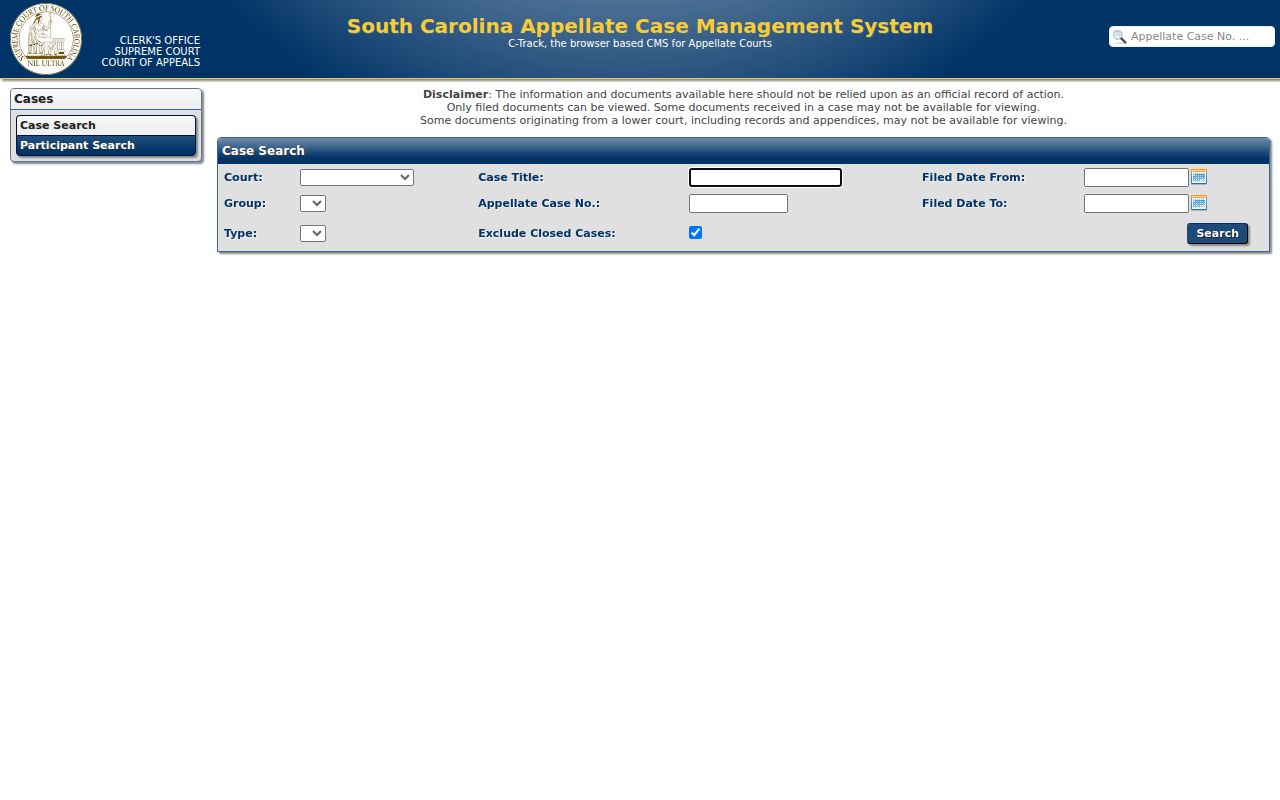
The appellate entry does not erase the lower judgment by itself. Read the decision and subsequent trial-court entries to see what relief, if any, was granted.
Access & Restrictions
The South Carolina Freedom of Information Act supports access to public records, but court access also reflects sealing rules and protections for juveniles, victims, minors, medical information, and personal identifiers. Online rows can be more limited than the maintained file. Active matters may also lack a final result simply because the case is still moving.
South Carolina expungement can remove qualifying public records after outcomes such as dismissal, nolle prosequi, or acquittal. The state expungement statute describes destruction of qualifying arrest and booking records, associated warrants, photographs, and fingerprints while allowing narrow sealed retention of investigative material.
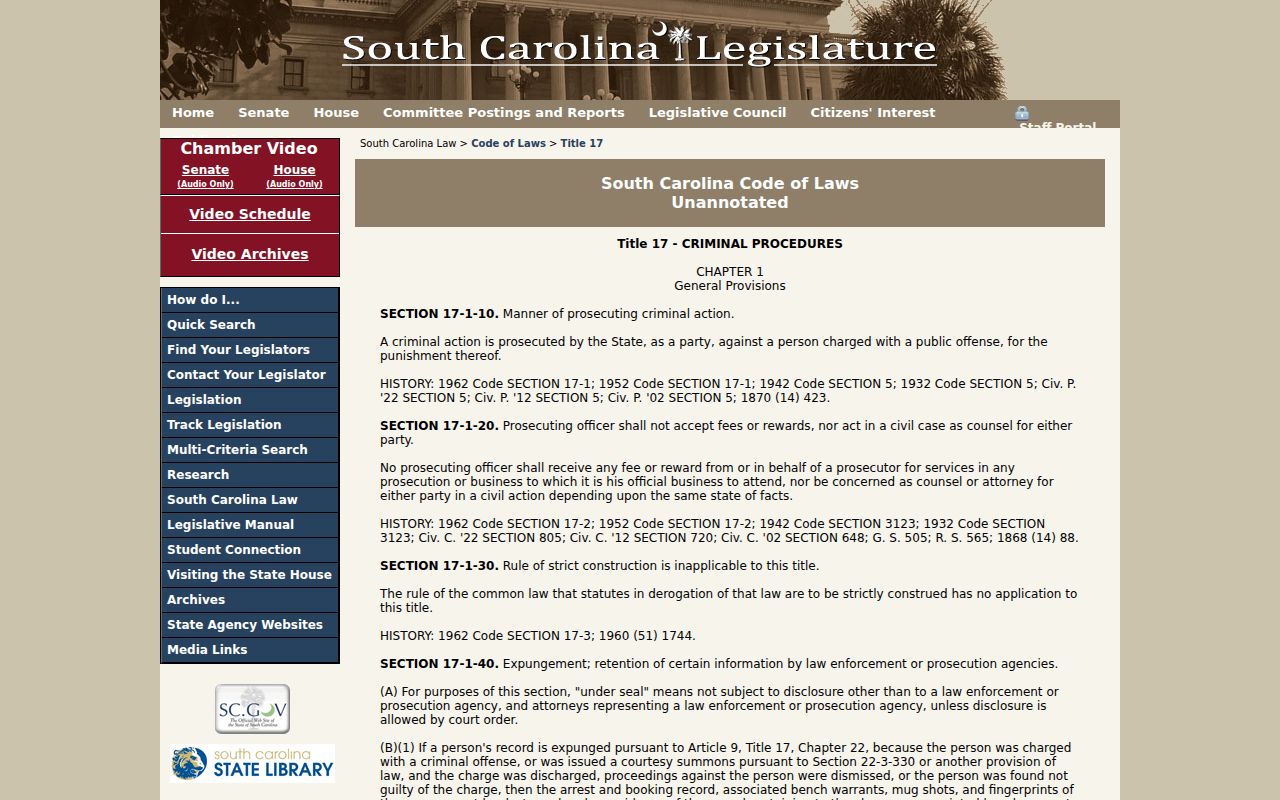
The statute image reinforces a vital distinction: limited agency retention does not make a record open to the public. If CATCH still shows an outcome incorrectly, obtain a certified Oconee County disposition and use SLED's correction route.