
How to Check Criminal History in Oconee County
Begin with the question the record must answer. The Oconee Public Index is the best first stop for a filed General Sessions case, its charge history, and its disposition. A disposition is the way a charge ended. City traffic, ordinance, and lower criminal matters may remain with a municipal court. A current jail inquiry belongs with the Oconee County Detention Center, while a statewide repository report comes from SLED. Gather the full name, likely spelling variants, an approximate date, and a date of birth when the official system lawfully requests it. Common names need more than one matching point.
The official Judicial Branch Oconee directory shows the county court offices that support the search. The directory image below helps identify the official court route, not a private people finder.
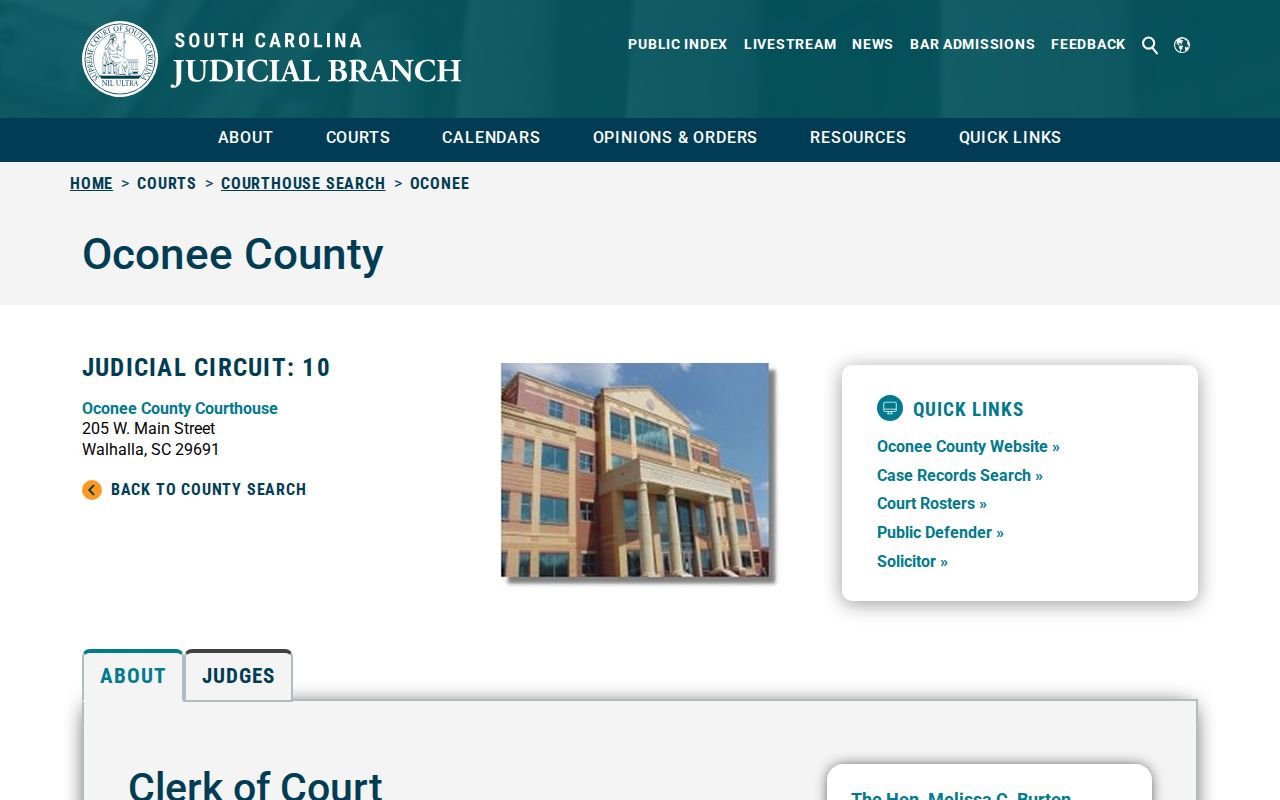
Use that directory to confirm the right clerk before calling or visiting, since judges and assignments can change.
- Search Oconee County in the Public Index by party name or a known case number.
- Match the county, dates, party role, and charge context before treating a row as the right person.
- Read the docket and disposition fields. Do not treat the first charge as the final result.
- Check the city court, arresting agency, or detention office when the event does not appear in General Sessions.
- Ask the Clerk for the exact file or a certified copy after locating its case number.
Four Oconee Criminal Record Systems
Oconee County criminal records divide by purpose. The Public Index is case-centered. SLED CATCH is repository-centered and depends on fingerprint and disposition reporting. The detention center is custody-centered. SCDC is prison-centered. A person may have a court case yet no current custody entry, or a fresh booking that has not reached a filed court docket. Those are different time points, not automatic proof that one office is wrong.
| Official channel | Best answer | Key limit |
|---|---|---|
| Oconee Public Index | Filed case, docket, charge, and outcome | Not a full police narrative or statewide history |
| SLED CATCH | Name and birth-data match in the state repository | Can miss an event not linked or reported correctly |
| Oconee Detention Center | Current or recent county booking and custody | Does not decide guilt |
| SCDC Inmate Search | Current sentenced state imprisonment | Excludes county detainees and community supervision |
For a sound Oconee County record check, use the narrow system first and confirm the outcome in the court file. A booking charge may later be amended, dismissed, or replaced by an indictment.
Official South Carolina Background Checks
The South Carolina Law Enforcement Division runs CATCH, the public name-based state product. A user accepts the portal terms, enters the requested identity data, pays the nonrefundable base charge, and prints the report. Mail requests go to the SLED Records Department with the Criminal Records Check Form, payment, and a self-addressed stamped envelope. State questions can go to the Public Dissemination Unit at 803-896-1443 on weekdays from 9 a.m. to 4:30 p.m. A person who needs a notarized or certified result must state that need.
The official SLED CATCH gateway shows the current terms and price notice used for an Oconee County criminal history request.
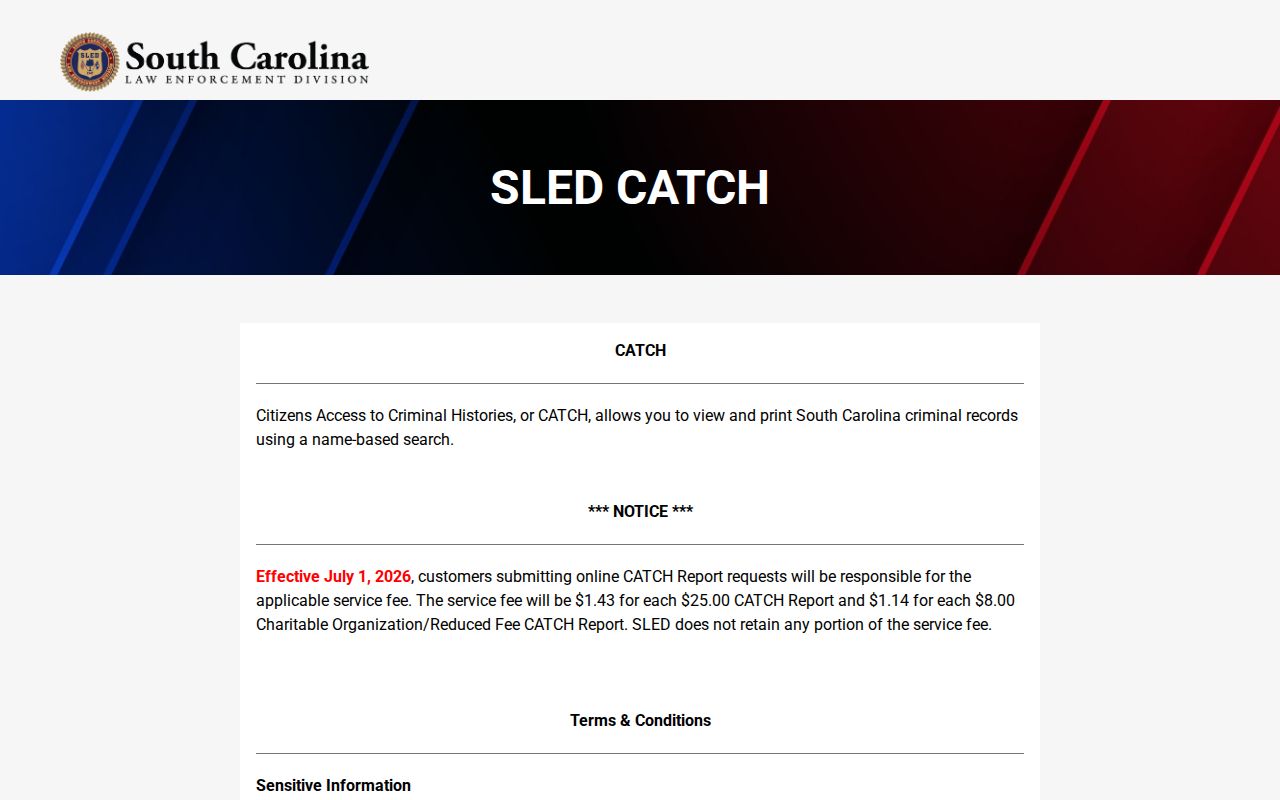
The gateway is a state repository route. It is not the Oconee case docket, jail roster, or sex offender registry.
| Official product | Known cost | Method |
|---|---|---|
| CATCH online | $25 plus the applicable online service fee; the July 2026 notice states $1.43 | Name and birth data |
| CATCH by mail | $25; no online fee | Form, payment, and stamped return envelope |
| Seneca fingerprint capture | Fee not published in the reviewed text | Pay at City Hall, then take the receipt to police dispatch |
| FBI Identity History Summary | Verify the current federal fee | Subject-only fingerprint request |
Oconee Criminal Records Need Fingerprints
Typed names do not create the link between an arrest and South Carolina's repository. Fingerprints do. SLED warned in 2026 that charges without a supporting fingerprint submission may never enter the repository. Changed charges and direct indictments can need new reporting as well. Its update said only seven percent of direct indictments from 2025 through the report date had reached the repository. That finding makes a court search essential when CATCH and a known Oconee County case do not match.
The SLED CJIS overview identifies the state unit that stores and disseminates criminal identification records.
When a state entry is wrong, obtain the certified Oconee disposition and identify the disputed arrest cycle for SLED's correction process.
Seneca Police offers local ink-card fingerprint service on Tuesday and Thursday from 1 to 3 p.m. The person pays at City Hall first, then brings the receipt to dispatch at 205 N. Depot Street. The service is not for concealed-weapons-permit fingerprints. No official Oconee vendor enrollment site or vendor fee was verified, so a private shop should not be labeled an authorized state channel.
Types of Oconee County Criminal Records
An incident report describes an alleged event and officer response. An arrest report records the custody decision and probable-cause basis. Oconee County Detention Center then creates a booking file with intake, charges, holds, bond, fingerprints, and release data. The Clerk's General Sessions file carries the indictment, motions, hearings, plea or trial, disposition, and sentence. Municipal and magistrate courts keep their own lower-court matters, so those files do not become interchangeable merely because the person was booked at the county jail.
- Agency reports: request incident and arrest narratives from the Sheriff or city police department that created them.
- Court records: use the Oconee Public Index and Clerk for filed charges, docket events, copies, and final outcomes.
- Custody records: ask Oconee detention staff about county custody and use SCDC for current state prison custody.
- Supervision records: read the sentence and violation docket, then contact SCDPPPS for operational probation or parole questions.
- Registry records: use SLED SORT for public sex offender information and its community notification tools.
Warrants form another record class. Oconee County had no verified official active-warrant portal in the research. Call the issuing court and Sheriff, and check the related case. A bench warrant often addresses failure to appear or comply. It is not a fresh finding of guilt.
Older Oconee Criminal Case Searches
The Clerk states that its computer court index begins in 1994. Earlier Oconee County criminal case research runs through index books. That is a real change in method, not just a slower web search. The Clerk can provide copies in person or by mail for a fee, but staff do not conduct open-ended research and do not give legal advice. Arrive with a name, an approximate year, or a case number, then identify the exact file before asking for copies.
The office is at 205 W. Main Street in Walhalla and is open weekdays from 8:30 a.m. to 5 p.m. Call 864-638-4280 to confirm access and entry details. Court security screening applies. Official sources did not publish a universal parking, phone, locker, or recording policy, so those details should be confirmed rather than assumed.
Oconee Clerk of Court
205 W. Main St.
Walhalla, SC 29691
864-638-4280
Weekdays, 8:30 a.m.-5 p.m.
Oconee Detention Center
300 S. Church St.
Walhalla, SC 29691
Call before a records-counter visit.
Note: The Clerk supplies located records and copies, but the requester must do the name and index research.
What an Oconee County Criminal Record Shows
The fields depend on the record. A repository history groups identity data, aliases, a state identification number where authorized, arrest agency and date, fingerprint-supported charges, and reported court outcomes. The General Sessions file is more detailed about one prosecution. It may show a case number, indictment date, offense code, bond, attorneys, hearings, events, disposition, and sentence. A booking sheet focuses on intake, holds, bond, and release. Protected victim, minor, medical, and full Social Security number data are not public fields.
- Disposition
- The recorded way a charge ended, such as guilty, dismissed, acquitted, or nolle prossed.
- Nolle prosequi
- A prosecutor's formal choice not to continue the charge, often displayed as “nolle prossed.”
- Arrest cycle
- The repository group that ties a fingerprint-supported arrest to later reported outcomes.
- Bench warrant
- A judge's warrant, often issued after failure to appear or comply with an order.
- Remittitur
- The appellate court's return of its decision and jurisdiction to the lower court.
Read each status in context. “Pending” has no final result. A guilty or no-contest plea followed by sentence is a conviction. An appeal entry does not erase the lower judgment unless the reviewing court grants relief.
Reading Oconee Criminal Case Numbers
A common General Sessions number follows YYYY-GS-37-NNNNN. The first part is the year, “GS” marks General Sessions, and “37” is Oconee County's code. The final digits identify the case sequence. Common Pleas civil cases use “CP,” while municipal and magistrate numbering differs. The prefix helps route a file, but it does not prove that a person was convicted.
Search fields in the county portal let a reader use a case number or party name, then narrow by first and middle name, case type, or filing-date range when available. Interface labels can shift, but these are the functions documented for the South Carolina county portal.
| Search field | Use | Oconee note |
|---|---|---|
| Case Number | Direct case lookup | General Sessions format includes GS-37 |
| Last, First, Middle Name | Party-name search and narrowing | Try verified spelling variants |
| Case Type | Limit the result group | Choices depend on the portal view |
| Date Filed From / To | Limit by filing span | Useful for a known event period |
After opening a result, compare the arrest and offense dates, party role, court, and charge history. Do not rely on the name alone.
Oconee Criminal Record Access Laws
South Carolina's Freedom of Information Act allows inspection and copying of public records, but it also permits lawful redaction and withholding. Start with the routine product before filing FOIA: use the Public Index for a case, CATCH for the state repository, the police form for a report, and SORT for registry data. A precise request is faster to evaluate than a demand for “everything.” A public body may charge actual search, retrieval, redaction, and reproduction cost and may seek a deposit up to one quarter of the estimate.
The South Carolina FOIA text shows the rules that apply to Oconee County criminal records.
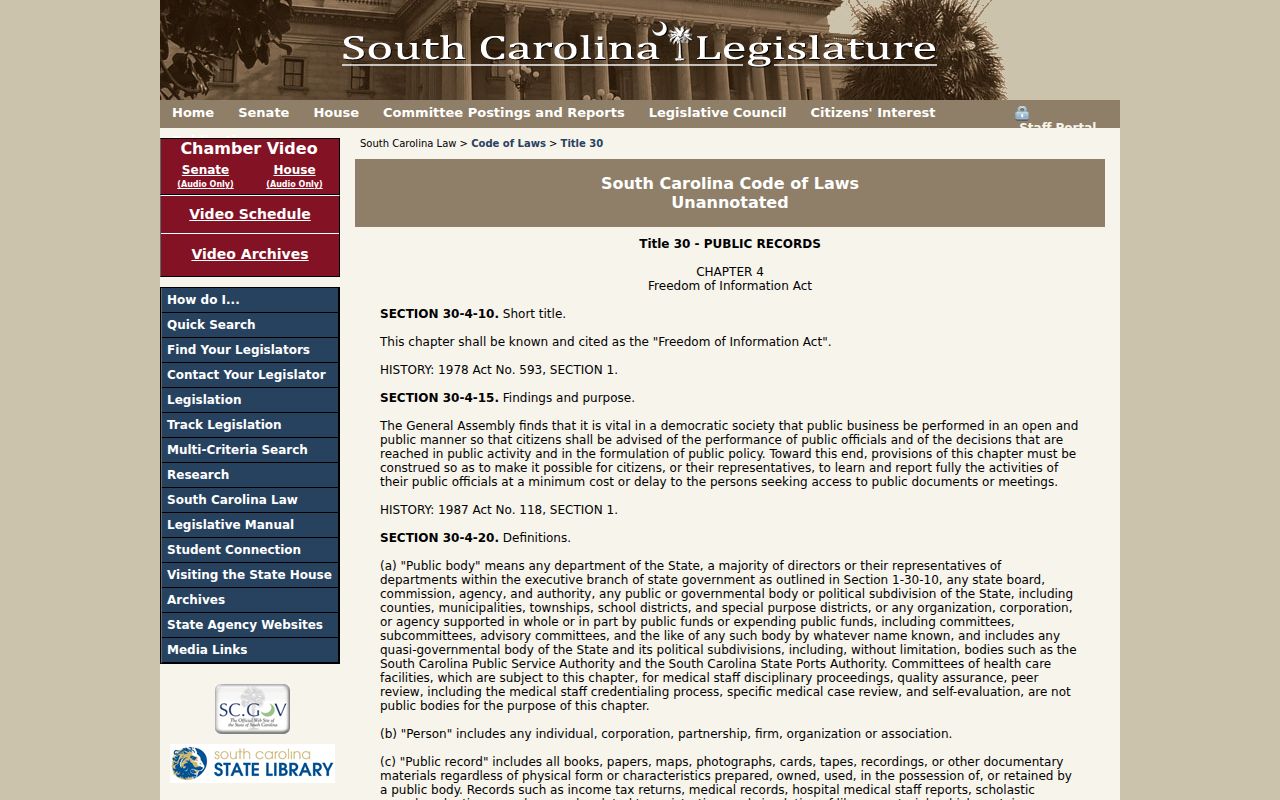
That law sets the request framework while other laws protect juvenile, victim, medical, investigative, and security information.
Key statutes:
S.C. Code §§30-4-30 and 30-4-40 provide access procedures, timing, costs, exemptions, and redaction authority.
S.C. Code §30-4-50 restricts commercial solicitation using incident-report information obtained through FOIA.
S.C. Code §§17-1-40 and 17-1-45 address expungement effects and notice of possible eligibility after certain outcomes.
S.C. Code §§23-3-400 through 23-3-550 govern the state sex offender registry, tiers, access, and removal routes.
Requesting Oconee Sheriff Criminal Records
The Sheriff's Office is the main fallback for its incident, arrest, booking, detention, and dispatch records. Use the official FOIA form to identify an existing record. Give the incident or booking date, agency case number if known, names as recorded, event location, record type, and desired format. Ask the arresting city department for its own narrative even when Oconee County later handled the booking.
The Oconee County Sheriff's official site identifies the county law-enforcement channel.

Use the Sheriff form for a defined agency record, not as a substitute for a statewide CATCH report or Clerk case search.
South Carolina FOIA normally gives the agency ten business days to determine a current-record request and twenty business days for records more than 24 months old. When access is granted, production ordinarily follows within 30 calendar days, or 35 for the older set, unless the parties agree otherwise. Active investigations, informants, juveniles, victims, medical facts, and security data may be withheld or redacted. No fixed Sheriff fee schedule was found, so current cost should be confirmed with the office.
Restricted and Expunged Oconee Records
South Carolina expungement depends on the outcome and the authorizing statute. A charge that was discharged, dismissed, nolle prossed, or ended in not guilty is a clear category for possible review. Under §17-1-40, an order can require destruction of the related arrest and booking record, bench warrants, mugshot, and fingerprints. Law enforcement and prosecutors may keep specified investigative material under seal for limited official uses. Sealed retention is not continued public access.
Obtain every Oconee County case number and disposition first. Then identify the correct eligibility route and contact the Tenth Circuit Solicitor for its application, verification charge, administrative fee, and current payment steps. The research did not locate an official Oconee-specific fee, so no local dollar figure should be assumed. After an order is distributed, verify the Public Index and CATCH. If SLED still displays an error, use the certified disposition and order in the correction process.
Juvenile material, protected victim and minor identities, active investigative content, Social Security numbers, and medical facts have separate access limits. A missing online row may reflect a restriction, an old paper index, or a reporting gap. It does not reveal which reason applies.
Oconee Jail and Prison Records
Oconee County Detention Center receives prisoners from the Sheriff, Seneca, Walhalla, Westminster, Salem, West Union, Highway Patrol, DNR, SLED, and other agencies. It holds pretrial detainees and short local sentences. An official 2023 report counted 3,081 arrestees processed, compared with 3,124 in 2022. Those figures count people processed by the jail, not crimes or convictions. The same report recorded 151 releases to electronic monitoring as a bond condition.
No working official Oconee roster was verified. The sound fallback is detention phone contact followed by a focused Sheriff records request. Commercial mugshot and “county records” sites are not substitutes. For a later state sentence, use the SCDC Inmate Search, which updates from the prior midnight and excludes county detainees, released people, juveniles, fugitives, and probation or parole supervision.
The official South Carolina VINE phone system adds custody lookup and notifications. Federal cases and custody remain separate: PACER covers federal dockets, and the Bureau of Prisons locator covers federal prisoners.
Note: An Oconee booking establishes custody at a point in time, while the court disposition establishes how the filed charge ended.
Criminal Records by City in Oconee County
City police departments write their own reports, and municipal courts keep city traffic, ordinance, and lower criminal files. Seneca offers detailed report and FOIA forms plus limited fingerprint hours. Walhalla publishes court rules for appearances, jury requests, missed dates, and its Alcohol Education Program. Westminster provides report copies and clearly limits its local conviction check to that police agency. All three send arrestees to the county detention center, but the first report request still belongs with the agency that created it.
Seneca Criminal History
2020 population 8,850. Police forms, fingerprint service, and a city municipal court.
Walhalla Criminal History
2020 population 4,072. City court and police records in the county seat.
Westminster Criminal History
2020 population 2,353. Local report access and magistrate-contracted court service.
Municipal dockets are not interchangeable with Oconee General Sessions records. Call the city clerk when a lower case or bench warrant does not appear in the county index.
Federal Oconee Criminal Record Layer
Oconee County lies in the U.S. District Court for the District of South Carolina. Federal criminal cases do not appear in the Oconee Public Index. PACER is the official docket and filed-document service and requires an account under its current fee policy. CourtListener's RECAP collection may have free contributed copies, but it is not the official filing system. The federal courthouse site supplies current location and divisional information.
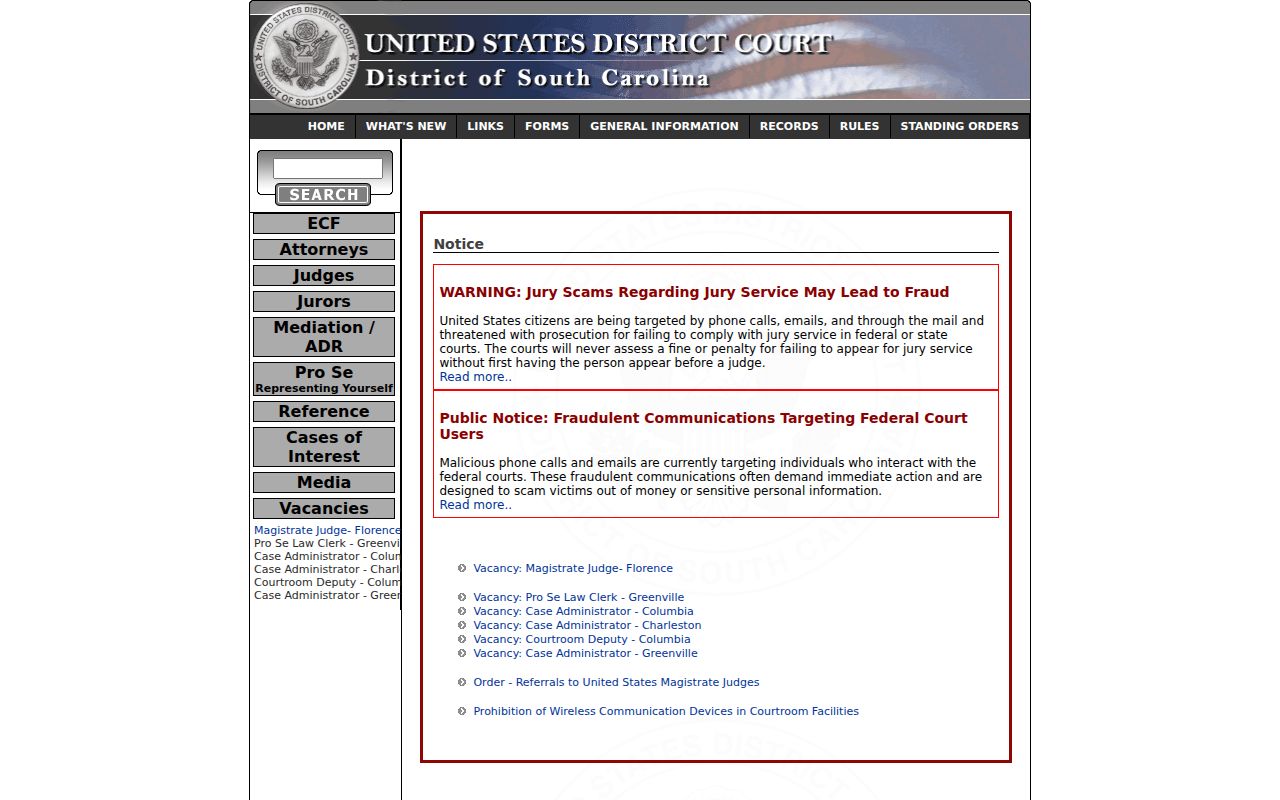
The District of South Carolina site shows the official federal court source.
Use the Bureau of Prisons locator for federal custody, not SCDC or the Oconee jail. A federal self-review follows the FBI Identity History Summary fingerprint process. No federal prison facility was identified within Oconee County.